









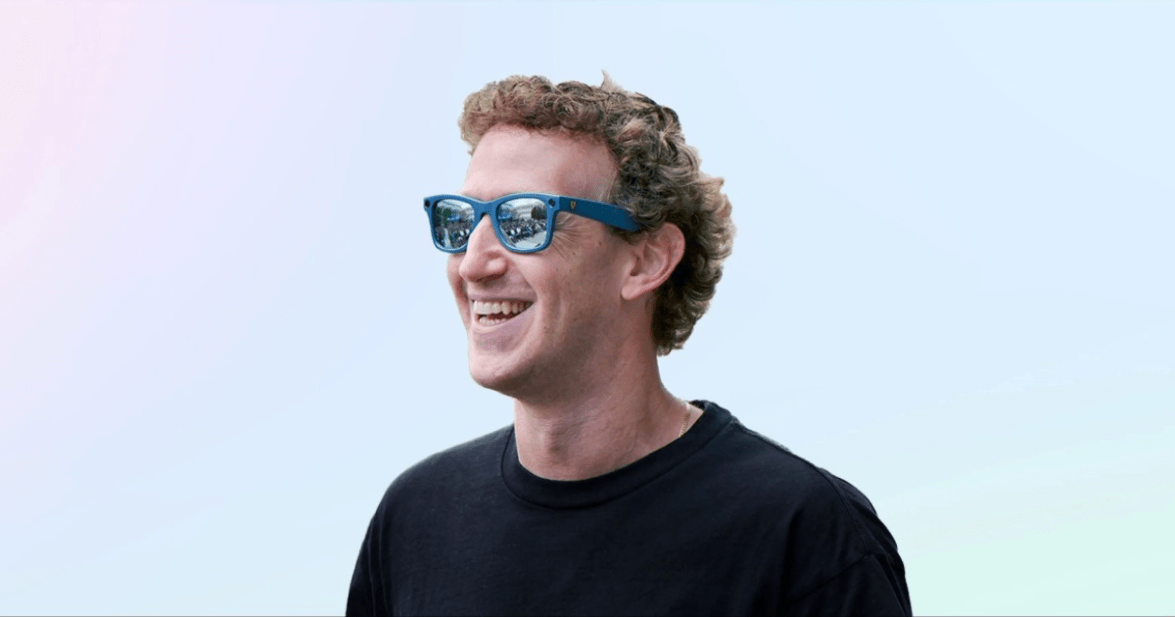
Meta CEO Mark Zuckerberg has doubled down on his belief that AI-powered smart glasses will become the primary interface between humans and artificial intelligence, warning that people without such devices may eventually find themselves at a “cognitive disadvantage.”
Speaking during Meta’s second-quarter earnings call on Wednesday following a blog post on “superintelligence” earlier in the day Zuckerberg laid out his vision for a future where smart eyewear becomes the dominant form factor for AI interaction.
“I continue to think that glasses are basically going to be the ideal form factor for AI,” Zuckerberg told investors. “Because you can let an AI see what you see throughout the day, hear what you hear, talk to you… [and] adding a display unlocks even more value.”
Meta has made substantial bets in this space with its Ray-Ban Meta smart glasses and a newly announced Oakley collaboration, both of which feature built-in cameras, audio, and Meta AI integration. These products have become a surprise hit, with sales reportedly tripling year-over-year, according to partner EssilorLuxottica.
Zuckerberg envisions an evolution beyond current capabilities toward AR glasses with holographic displays, like Meta’s upcoming Orion AR model, which would enable immersive digital overlays and real-time AI assistance in everyday life.
“In the future, if you don’t have glasses that have AI or some way to interact with AI you’re probably going to be at a pretty significant cognitive disadvantage compared to other people,” he added.
Reality Labs: Billions Spent on the Future
Zuckerberg’s remarks also served as a strong defense of Reality Labs, Meta’s heavily subsidized division responsible for its AR/VR hardware and research. The unit posted a staggering $4.53 billion operating loss in Q2 contributing to a cumulative loss of nearly $70 billion since 2020.
Despite mounting costs, Zuckerberg described the division’s work as foundational to the company’s long-term strategy.
“This is what we’ve been maxing out with Reality Labs over the last 5 to 10 years doing the research on all these different things,” he said, referring to sensors, displays, and AI integration.
Competitive Landscape: Glasses vs. Pins vs. the Unknown
Zuckerberg’s comments come as other major players explore alternative AI hardware. Earlier this year, OpenAI acquired the hardware startup of ex-Apple design chief Jony Ive in a $6.5 billion deal to build next-generation AI consumer devices.
While glasses are gaining traction due to their social acceptability and familiarity, some companies have tested other wearable interfaces. AI pins like the much-hyped but ultimately underwhelming Humane AI Pin and pendants from startups like Limitless and Friend offer different approaches to hands-free AI interaction.
However, Zuckerberg insists glasses are “awesome” not just for practical reasons, but because they merge the physical and digital worlds, reinforcing Meta’s long-term Metaverse vision.
“The whole Metaverse vision is going to end up being extremely important, and AI is going to accelerate that,” he said.
A Future Still Unwritten
As tech giants race to define the next frontier of AI consumer hardware, it remains to be seen whether glasses, pendants, or entirely new form factors will win the public’s favor. Still, Zuckerberg is placing his bets and billions on a vision where smart glasses become as indispensable as smartphones.